
Bulker
Bulker lets you ask questions and get detailed user insights in minutes by simulating interviews with 20 diverse AI personas.
Visit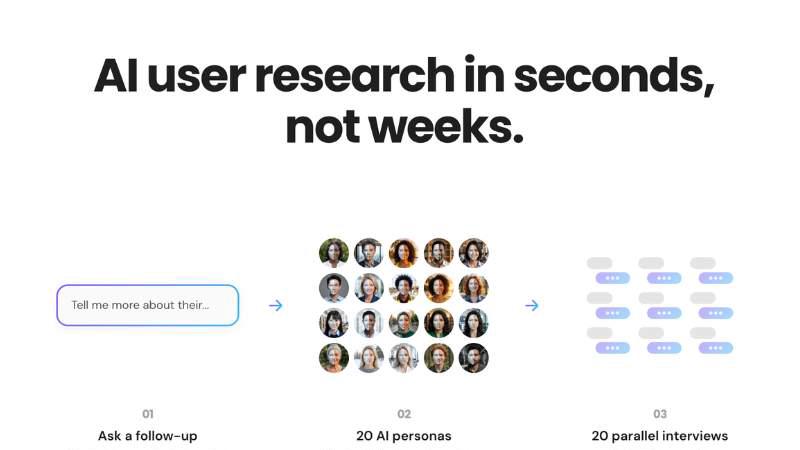
About Bulker
Bulker is an AI-powered user research tool designed specifically for entrepreneurs, startup founders, and product managers who need fast, reliable insights without the traditional hassle of recruiting participants, scheduling interviews, or waiting weeks for results. The product addresses a fundamental pain point: the friction and time cost associated with conventional user research methods. Bulker replaces human research panels with AI-simulated personas that are grounded in real-world demographic data from sources like the World Bank, United Nations, and web search. Users simply ask a question, and within minutes, the platform conducts 20 parallel interviews with these AI personas, each facilitated by a dedicated AI interviewer. The system then categorizes responses, visualizes data with interactive charts, performs automated fact-checking on major claims, and synthesizes everything into a comprehensive report. This report includes key themes, direct persona quotes, demographic breakdowns showing how opinions vary by age, location, occupation, and worldview, and fact-check verification with linked sources. Bulker is built for speed and affordability, offering a complete research session for approximately $15, which is about seven times cheaper than traditional user research methods. The platform is ideal for validating product ideas, testing market sentiment, gathering UX feedback, and accelerating decision-making processes.
Features of Bulker
AI Persona Panel Construction
Bulker constructs a diverse panel of 20 AI personas for each research session. These personas are not generic or random; they are grounded in real demographic data sourced from the World Bank, United Nations, and web search. The system uses a sophisticated methodology involving demographic stratification based on age, gender, income, urbanization, and education. It then applies a largest-remainder allocation algorithm with integer optimization and diversity constraints to ensure a representative sample. Each persona is further developed using OCEAN personality candidates and typicality scoring to create realistic, nuanced simulated individuals.
Parallel Independent Interviews
Each of the 20 AI personas is interviewed independently by a dedicated AI interviewer in an isolated context. This prevents any cross-contamination of responses and mimics the structure of real, one-on-one user research interviews. The interviews are conducted in a native-language dialogue format, allowing for natural conversational flow. Users can ask follow-up questions to all personas simultaneously or open a private chat with any single persona to explore their perspective in greater depth, providing both breadth and depth of qualitative data.
Real-Time Fact Verification
Major claims made by the AI personas during interviews are automatically validated through a real-time fact-checking system. This feature sources claims against grounded data and web search results, flagging any responses that are inaccurate, unverifiable, or based on false premises. The fact-check results are included in the final report, with linked sources for verified claims and clear annotations for flagged ones. This ensures that the insights generated are not only qualitative but also grounded in factual accuracy, increasing the reliability of the research output.
Comprehensive Synthesized Reporting
Every research session produces a detailed, structured report that goes far beyond raw data dumps. The report synthesizes findings from all 20 interviews into key themes, highlighting standout and surprising insights. It includes direct quotes from individual AI personas that support each finding, providing qualitative depth. The report also features demographic breakdowns showing how opinions differ by age, location, occupation, and worldview, enabling segmentation analysis. Finally, it incorporates the fact-check verification results, making it a complete, actionable deliverable for decision-making.
Use Cases of Bulker
Product Discovery and Validation
Startup founders and product managers can use Bulker to quickly validate new product ideas before investing significant resources in development. By posing questions about pain points, desired features, and willingness to pay, users can gauge market interest and identify potential issues within minutes. For example, asking "Would parents pay for an AI tutor for their kids?" generates immediate, diverse feedback from 20 simulated personas representing different demographics, providing early-stage validation that traditionally takes weeks of recruiting and interviewing.
Market Sentiment Analysis
Bulker enables rapid assessment of market sentiment around specific topics, industries, or trends. Users can probe how different demographic groups feel about emerging technologies, economic shifts, or cultural changes. For instance, asking "How do small business owners feel about AI replacing their marketing?" produces a nuanced understanding of fears, opportunities, and adoption barriers across different business types and regions. This allows companies to tailor their messaging and product strategies to actual market perceptions.
UX and Usability Feedback
Product teams can use Bulker to test user experience concepts, new features, or interface designs before coding begins. By simulating user reactions to proposed workflows, navigation changes, or onboarding processes, teams can identify usability issues and areas of confusion early. The conversational depth of the AI interviews allows for follow-up questions like "What would make this feature easier to use?" providing actionable feedback that improves the final product while reducing development cycles.
Content and Messaging Testing
Marketers and content creators can test the effectiveness of different messaging strategies, taglines, or campaign concepts with Bulker. By presenting various copy options and asking which resonates most, users can understand what language appeals to different segments. For example, testing whether "eco-friendly" packaging claims influence buying decisions across age groups provides concrete data for campaign optimization. The demographic breakdowns reveal which messages work best for which audiences, enabling more targeted and effective communication.
Frequently Asked Questions
How does Bulker ensure the AI personas are representative of real populations?
Bulker grounds its AI personas in real-world demographic data from authoritative sources including the World Bank, United Nations, and web search. The platform uses a rigorous methodology that starts with demographic stratification across age, gender, income, urbanization, and education. It then applies a largest-remainder allocation algorithm with integer optimization and diversity constraints to build a panel that reflects target population distributions. Each persona is further developed using OCEAN personality traits and typicality scoring to create realistic, nuanced simulated individuals. The system provides full transparency, allowing users to see exactly how their panel was constructed and inspect diversity metrics at any time.
Can I ask follow-up questions during a research session?
Yes, Bulker supports follow-up questions in two ways. You can ask a follow-up question to all 20 personas simultaneously, which is useful for exploring a theme that emerged from initial responses. Alternatively, you can open a private chat with any individual persona to explore their perspective in greater depth. This conversational depth allows you to probe surprising answers, clarify ambiguous responses, or dig deeper into specific viewpoints, mimicking the flexibility of real, moderated user research interviews.
How does the fact-checking feature work?
Bulker automatically validates major claims made by AI personas during interviews against grounded data sources and web search results. The system flags any response that is inaccurate, unverifiable, or based on false premises. Verified claims are linked to their sources for transparency. This real-time fact-checking ensures that the insights you receive are not just qualitative opinions but are grounded in factual accuracy. The results are included in your final report, with clear annotations distinguishing verified claims from flagged ones.
What kind of report does Bulker produce?
Every research session produces a comprehensive, synthesized report that goes beyond raw data. The report includes synthesized themes identifying key patterns across all 20 interviews, with standout and surprising insights highlighted. It contains direct persona quotes that support each finding, providing qualitative depth. The report also features demographic breakdowns showing how opinions differ by age, location, occupation, and worldview, enabling segmentation analysis. Finally, it incorporates fact-check verification results with linked sources for verified claims and flags for inaccurate ones. This structured report is designed to be immediately actionable for decision-making.
Pricing of Bulker
A standard Bulker research session runs 20 AI personas across 10 questions for a cost of $15. This pricing is approximately seven times cheaper than traditional user research methods, which can cost around $100 per interview for similar sample sizes. The platform offers a free trial option, allowing users to test the service before committing to a paid session.
Similar to Bulker

privacy-first, AI-powered contact management platform

SnapPChart grades a trading chart screenshot A+ to F, with an entry, stop, targets, and risk/reward. Works on stocks, forex, crypto, futures.

Spreadsheet-native work management with AI formulas, dashboards, automation, reporting, and project views for growing teams.


A simpler Google Analytics dashboard for understanding GA4 traffic, pages, users, and performance without the complexity.


AIQualityHQ instantly evaluates your prompts across six key dimensions, delivering deterministic scores and actionable fixes in under 10ms.

SeeCalc provides free, instant, client-side calculators for marketing, health, construction, and finance with transparent step-by-step formulas.