
Serro AI
Serro AI is a coordination layer that keeps your team's shared program memory live and aligned across all your tools.
Visit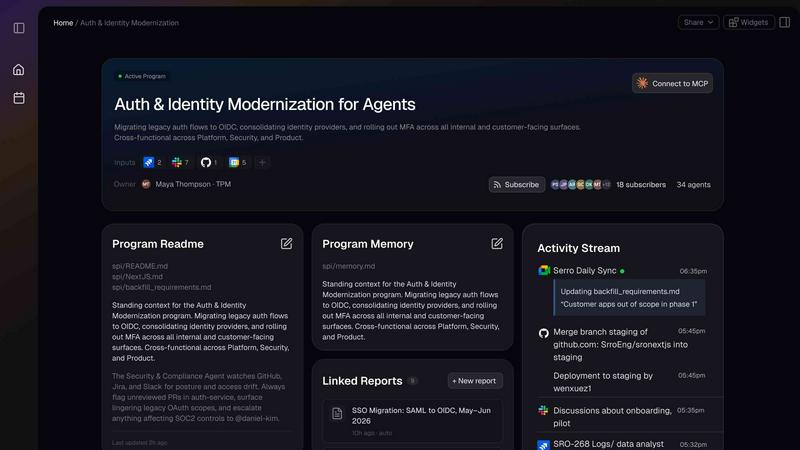
About Serro AI
Serro AI is an Agentic Technical Program Management (TPM) platform, purpose-built to address the modern coordination bottleneck in engineering organizations. As AI accelerates code output, the ability to coordinate across teams, tools, and timelines has become the primary constraint on velocity. Serro treats programs as first-class units of work, moving beyond traditional task trackers, roadmap tools, documentation wikis, or generic project management platforms. It ingests scattered execution signals from tools like Jira, GitHub, Linear, Slack, meeting transcripts, documents, and roadmaps, transforming them into two core outputs: trusted temporal program memory and real-time status coordination. Program memory is a living record of shared goals, decisions, risks, dependencies, and historical context that stays current automatically. The coordination layer enables both humans and AI agents to act on the same unified view of work. Serro is designed for technical program managers (TPMs), engineering managers (EMs), product managers (PMs), and engineering leaders who need to manage complex, cross-functional programs at scale. The platform offers two tiers: Serro Pro for enterprises seeking to scale existing TPM capacity across multiple downstream programs and agent loops, and Serro Lite for earlier-stage companies that need AI-powered TPM capabilities to help smaller teams scale live coordination without a large program management headcount. By meeting users where they already work, through meetings, chat, and tool integrations, Serro acts as a shared operating system for human-agent organizations, helping teams move faster without drift.
Features of Serro AI
Program Memory
Serro provides live memory across every active program. It automatically ingests signals from connected tools like Slack, Linear, GitHub, Jira, Zoom, Notion, email, and your codebase to build a continuously updated state of each program. This memory captures decisions, risks, owners, history, and activity, ensuring that context is never lost or reconstructed after the fact. Teams can query any program at any time and receive an accurate, current picture of what is happening, who is responsible, and what the next steps are. This eliminates the need for manual status updates and reduces the cognitive overhead of tracking multiple workstreams.
Loops on Programs
Serro enables loops that keep complex work moving. These are automated workflows and coordination cycles that drive execution across teams and tools. Loops can be configured to generate regular status reports, follow up on action items from meetings, escalate blockers, and synchronize dependencies between programs. They act as persistent, intelligent processes that ensure nothing falls through the cracks. By automating routine coordination tasks, loops free up TPMs and managers to focus on higher-level strategic decisions and exception handling.
Agent Governance
Serro includes a control layer for programs and agents, providing governance over how AI agents interact with program data and execution. This feature ensures that autonomous agent actions remain within defined boundaries, respecting program policies, access controls, and decision-making hierarchies. It allows organizations to safely deploy AI agents to assist with coordination tasks, such as updating status, flagging risks, or generating reports, without risking data integrity or unauthorized changes. Agent governance is critical for maintaining trust and accountability in human-agent teams.
Program Analytics
Serro offers a system-level view across the entire organization through program analytics. This feature provides dashboards and reporting that surface organizational health, momentum, coordination gaps, blockers, and operational risk in real time. Leaders can see how programs are progressing, where resources are constrained, and which dependencies are at risk. Analytics transform fragmented updates from multiple tools into a coherent, live picture of program health, enabling faster, data-driven decisions at scale.
Use Cases of Serro AI
For Technical Program Managers (TPMs)
TPMs can delegate the overhead of manual coordination and scale their impact across more programs. Serro automatically ingests signals from across the tool stack, builds and maintains program memory, and generates status reports on cadence. TPMs can query any program in natural language, get real-time updates on blockers and risks, and turn meeting outcomes into actionable tasks. This allows them to manage multiple cross-functional programs simultaneously without being buried in status meetings or spreadsheet updates.
For Engineering Managers (EMs)
EMs gain a clear understanding of reality across their teams without chasing updates. Serro provides a shared view of what is moving, where execution is slipping, and what needs attention next. Managers can see dependencies between teams, track delivery progress against timelines, and monitor team health through the platform. This reduces the time spent in sync meetings and allows EMs to focus on removing blockers and supporting their engineers, while staying aligned with broader program goals.
For Product Managers (PMs)
PMs can keep decisions, timelines, and execution aligned across product and engineering teams. Serro connects roadmap shifts, strategic decisions, ownership assignments, and delivery progress in one live view. As priorities evolve, the platform ensures that teams remain aligned on the current product direction and that execution stays tied to the roadmap. PMs can use Serro to communicate changes, track the impact of decisions, and ensure that product goals are reflected in daily work.
For Engineering and Executive Leadership
Leaders get a real-time view of organizational health and operational risk. Serro aggregates data from all active programs to surface momentum, coordination gaps, and potential bottlenecks. Instead of relying on fragmented updates from multiple sources, executives can access a single, trusted picture of program health. This enables faster, more informed decisions about resource allocation, strategic pivots, and risk mitigation, ultimately improving the organization ability to deliver on its commitments.
Frequently Asked Questions
How does Serro differ from traditional project management tools like Jira or Asana?
Serro is not a task tracker or a generic project management platform. It is purpose-built for the Technical Program Management function, treating programs as first-class units of work rather than collections of tasks. While tools like Jira focus on individual task management and workflows, Serro ingests signals from those tools and others to build a live, temporal memory of program context, including decisions, risks, dependencies, and history. It provides real-time coordination that both humans and AI agents can act on, making it a coordination layer rather than just a task management system.
What tools does Serro integrate with?
Serro connects with a wide range of tools commonly used in engineering organizations, including Slack, Linear, GitHub, Jira, Zoom, Notion, email, and your codebase. It continuously ingests signals from these sources to build and maintain program memory. The platform is designed to meet teams where they already work, allowing them to interact with Serro through meetings, chat, and tool commands without requiring a separate workflow or interface.
Can Serro be used by smaller teams without dedicated TPMs?
Yes, Serro offers Serro Lite specifically for earlier-stage companies that do not have a dedicated TPM function. Serro Lite provides AI-powered TPM capabilities that help smaller teams scale live coordination, track programs, and manage dependencies without needing a large program management headcount. It allows teams to benefit from automated program memory and coordination loops, enabling them to operate with greater efficiency as they grow.
How does Serro ensure data security and governance for agent actions?
Serro includes an Agent Governance feature that acts as a control layer for programs and agents. This ensures that any AI agent actions, such as updating status, flagging risks, or generating reports, occur within defined boundaries. Organizations can set policies, access controls, and decision-making hierarchies to maintain trust and accountability. All agent actions are logged and auditable, providing a clear record of changes and ensuring compliance with organizational standards.
Similar to Serro AI


Free Online Screen Test Tool - Instantly diagnose dead pixels, lines, color issues, and flickering. Multiple test modes, no download needed.


Research keywords, competitors, backlinks and AI visibility in Claude or Codex. Keep the findings in your SEO dashboard.
