
Autheo
Autheo is a Layer-0 operating system with an integrated Layer-1 blockchain that unifies identity, compute, storage, and AI for scalable Web3.
Visit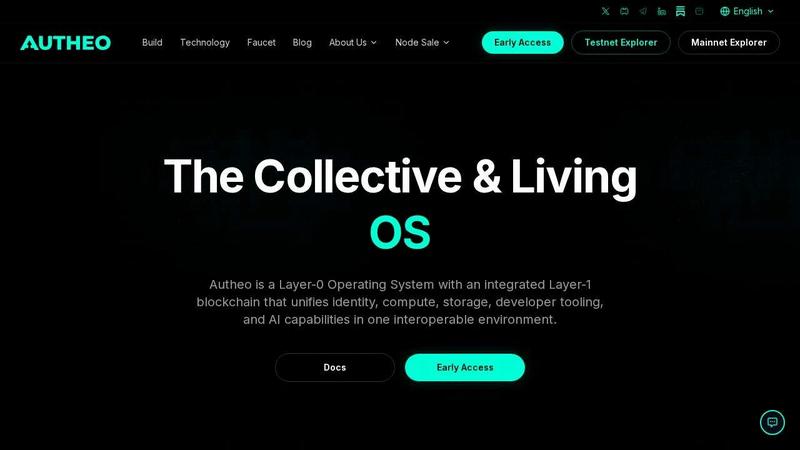
About Autheo
Autheo is a next-generation Layer-0 Operating System with an integrated Layer-1 blockchain designed to unify identity, compute, storage, developer tooling, and AI capabilities into a single interoperable environment. It addresses the fundamental fragmentation problem in Web3, where developers currently juggle multiple APIs, SDKs, and platforms while enterprises struggle to bridge the gap between Web2 and Web3 systems. Autheo provides a composable, programmable, and sovereign foundation that eliminates costly integrations and fragile systems. The platform is built for developers, enterprises, and innovators who want to launch scalable applications, sovereign ecosystems, and interoperable networks without piecemeal integrations. At its core, Autheo combines six essential components: a fast and sovereign Layer-0 plus Layer-1 blockchain foundation, decentralized cloud infrastructure with compute and storage, full-stack SDKs for frontend and backend development, DevHub as a native development environment, TheoID for post-quantum secure authentication, and THEO AI for intelligent automation. This unified approach creates a living network where every deployment fuels the collective and every interaction strengthens the ecosystem. As AI-native tools and agents join the stack, Autheo does not just scale but learns, adapts, and evolves over time. It represents the convergence of Web2 and Web3, turning fragmentation into an intelligent, integrated internet where builders stop renting infrastructure and start owning the internet itself.
Features of Autheo
Layer-0 Plus Layer-1 Architecture
Autheo combines a Layer-0 operating system with an integrated Layer-1 blockchain, providing a fast and sovereign foundation for all applications. This dual-layer architecture enables developers to launch custom chains, deploy smart contracts, and build scalable decentralized applications without the limitations of traditional single-layer blockchains. The Layer-0 handles cross-chain communication and interoperability, while the Layer-1 provides execution and settlement capabilities, creating a seamless environment for complex multi-chain workflows.
Core Infrastructure with Decentralized Cloud
The platform includes a comprehensive decentralized cloud infrastructure encompassing compute, storage, and messaging capabilities. This eliminates reliance on centralized cloud providers and gives developers true sovereignty over their data and applications. The decentralized infrastructure is fully integrated with the blockchain layer, enabling automated resource allocation, persistent storage for application states, and secure peer-to-peer messaging that scales with network demand.
Full-Stack SDKs
Autheo provides a unified framework of full-stack SDKs that cover frontend development, backend logic, smart contract creation, and application orchestration. Developers can build complete decentralized applications using a single toolchain, reducing the complexity of integrating multiple libraries and frameworks. The SDKs are designed for both Web2 and Web3 developers, offering familiar programming paradigms while unlocking blockchain-specific capabilities like tokenization, identity management, and decentralized governance.
DevHub Native Development Environment
DevHub serves as the native workspace for testing, deploying, and scaling projects on Autheo. It provides an integrated development environment with debugging tools, deployment pipelines, and monitoring dashboards specifically designed for the Autheo ecosystem. Developers can rapidly prototype ideas, simulate network conditions, and deploy production-ready applications directly from DevHub, significantly reducing time-to-market for new projects.
TheoID Post-Quantum Security
TheoID delivers post-quantum secure authentication and sovereignty for both people and digital assets. This identity system is designed to resist future quantum computing attacks, ensuring long-term security for users and applications. TheoID enables self-sovereign identity management where users control their personal data and digital assets without intermediaries, while providing seamless integration with Web2 authentication flows for enterprise adoption.
THEO AI Intelligent Automation
THEO AI brings intelligent automation and adaptive workflows to the Autheo ecosystem. AI-native tools and agents can automate complex blockchain operations, optimize resource allocation, and provide predictive analytics for decentralized applications. As the network grows, THEO AI learns from user interactions and network patterns, enabling the platform to evolve and adapt its capabilities over time without manual intervention.
Use Cases of Autheo
Sovereign Application Development
Developers can build and deploy fully sovereign decentralized applications that operate independently of centralized infrastructure. Using the full-stack SDKs and DevHub, creators can launch applications with integrated identity, storage, and compute capabilities. These applications benefit from the Layer-0 plus Layer-1 architecture, enabling cross-chain interoperability and scalability that traditional platforms cannot match.
Enterprise Web2 to Web3 Migration
Enterprises can seamlessly migrate existing Web2 systems to Web3 infrastructure using Autheo's unified environment. The platform bridges the gap between traditional enterprise architectures and decentralized technologies, enabling gradual migration without disrupting existing operations. Enterprises benefit from TheoID's secure authentication, decentralized storage for compliance, and AI-powered automation for business processes.
AI-Native Autonomous Systems
Autheo enables the creation of AI-native autonomous systems that leverage THEO AI for intelligent decision-making and workflow automation. These systems can manage decentralized autonomous organizations, automate supply chains, or power intelligent virtual assistants that operate on the blockchain. The living network adapts to these AI agents, creating an ecosystem that continuously learns and improves.
Cross-Chain DeFi and NFT Platforms
Developers can build cross-chain decentralized finance platforms and NFT marketplaces that operate across multiple blockchain networks through Autheo's Layer-0 interoperability. The integrated identity system ensures secure asset management, while the decentralized infrastructure provides reliable compute and storage for complex financial applications. THEO AI can optimize trading strategies and automate liquidity management.
Frequently Asked Questions
What is Autheo?
Autheo is a Layer-0 Operating System with an integrated Layer-1 blockchain that unifies identity, compute, storage, developer tooling, and AI capabilities in one interoperable environment. It provides a composable, programmable, and sovereign foundation for launching chains, applications, and intelligent systems that work seamlessly across Web2 and Web3 from day one.
What can I build on Autheo?
You can build a wide range of applications including sovereign decentralized applications, cross-chain DeFi platforms, NFT marketplaces, AI-native autonomous systems, enterprise Web3 migration solutions, gaming platforms, and decentralized identity systems. The platform supports full-stack development with integrated SDKs and a native development environment called DevHub.
How is Autheo different from Ethereum or Solana?
Autheo differs fundamentally by operating as a Layer-0 operating system with an integrated Layer-1 blockchain, rather than being a single-layer blockchain like Ethereum or Solana. It unifies six core components including identity, compute, storage, developer tooling, and AI capabilities into one environment. Additionally, Autheo features post-quantum secure authentication through TheoID and AI-native automation through THEO AI.
Is Autheo live?
Autheo is currently in its development phase with a Testnet Explorer available for early access. The platform has a growing community of over 100 co-founders and contributors across blockchain, AI, gaming, open-source, and infrastructure sectors. A Node Sale is also available for those who want to participate in the network's early stages.
Similar to Autheo

Rent a server without handing over your ID: a hand-checked directory of hosting providers that take Monero and ask for no KYC.


A Polymarket trading bot that automates a proven arbitrage and directional strategy on 5-15 minute crypto markets, with full source code access.


Bitcoin Loans Market simplifies your search for Bitcoin-backed loans by providing transparent comparisons of key terms and features.

Perpfinder delivers a comprehensive live dashboard of crypto perpetual data, tracking volume, fees, and open interest across 85 exchanges.

Clypto is a cross-chain DeFi exchange that enables instant low-fee swaps for over 6000 tokens across 16 blockchains with best rates and deep.