
RecordFlow
RecordFlow automatically saves Zoom cloud recordings to Google Drive and optionally deletes them from Zoom to free storage.
Visit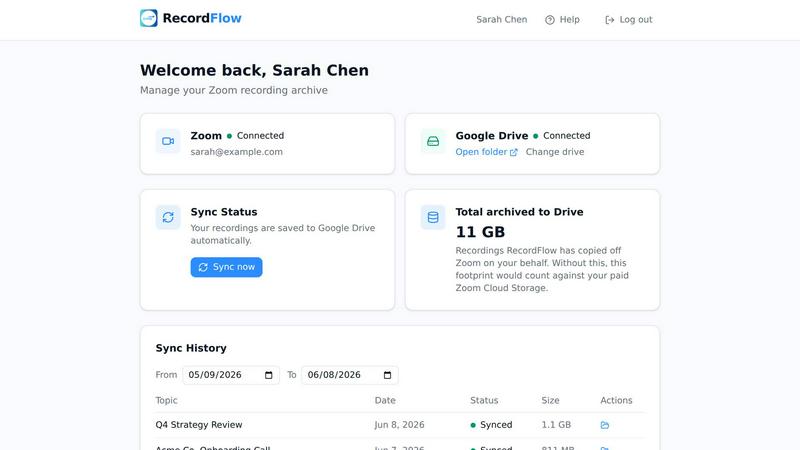
About RecordFlow
RecordFlow is a specialized software tool designed to automate the transfer of Zoom cloud recordings directly to Google Drive. Its core function is to eliminate the manual, time-consuming process of downloading recordings from Zoom and re-uploading them to a cloud storage service. The product automatically syncs every new Zoom cloud recording to a designated Google Drive folder within minutes of a meeting ending. It also offers a powerful backfill feature that can locate and transfer recordings from the past two years, ensuring no valuable content is left behind. The target audience includes professionals who rely heavily on recorded meetings for their work, such as coaches, consultants, therapists, professors, and small to medium-sized business teams. For these users, losing a recording or falling behind on manual archiving is not an option. The main value proposition of RecordFlow is the complete elimination of manual work, the prevention of lost or forgotten files, and the ability to free up Zoom storage by safely deleting recordings after they are verified in Google Drive. The setup process is remarkably simple, taking approximately 60 seconds to connect a Zoom account, link a Google Drive, and select a destination folder. Once configured, the system runs automatically and perpetually. RecordFlow is built with a focus on reliability, using chunked transfers for large files, smart deduplication to prevent duplicates, and automatic retries for failed transfers. It is also designed with security as a priority, using OAuth 2.0 for authentication, AES-256 encryption for data in transit and at rest, and a server architecture that never stores the recordings themselves, streaming them directly to the user's Drive.
Features of RecordFlow
Automatic and Continuous Sync
RecordFlow automates the entire backup workflow. Once a Zoom cloud recording is processed and available, RecordFlow detects it and initiates a transfer to the user's Google Drive. This process happens within minutes of the meeting's conclusion, without any manual intervention. The system runs continuously, meaning every new recording is captured and archived automatically, forever. This feature also includes a one-time backfill capability that scans and transfers eligible recordings from the past two years, providing a comprehensive archive from the moment of setup.
Comprehensive File Archiving
The product does not just transfer the video file. RecordFlow captures every file that Zoom generates for a cloud recording. This includes the primary video in MP4 format, the audio-only track in M4A, the transcript in VTT format, and the meeting chat log. For an even more organized experience, RecordFlow converts the VTT transcript into a formatted Google Doc and places it in the same folder. All files are organized into a clear folder structure by year and date, making navigation and retrieval simple and intuitive.
Intelligent Auto-Delete from Zoom
Zoom's cloud storage is a limited and often costly resource. RecordFlow offers an optional but powerful auto-delete feature to help users manage this. When enabled, the system will automatically delete the recording from Zoom's cloud after it has successfully transferred and verified the copy in Google Drive. A safe delay is built into this process to ensure the Drive copy is complete and intact before any deletion occurs. This feature frees up valuable Zoom storage space automatically, preventing the need to purchase additional storage or manually clean out old recordings.
Secure and Reliable Transfer Architecture
RecordFlow is engineered for both security and dependability. For large files, such as hour-long meetings, the system uses chunked transfers. This breaks the file into smaller pieces, preventing timeouts and ensuring the upload does not fail due to file size. The service also features smart deduplication, which means it is safe to re-run the sync process without creating duplicate files in Google Drive. Automatic retries handle transient network errors. Critically, RecordFlow streams the recording data directly from Zoom to the user's Google Drive, meaning the company's servers never store a copy of the recording. All data is encrypted using AES-256 during transit and at rest, and authentication is handled via OAuth 2.0.
Use Cases of RecordFlow
Coaches and Consultants Archiving Client Sessions
Coaches and consultants often record multiple client sessions each week. These recordings are not just for internal review but are frequently a deliverable for the client. Manually downloading each session, organizing it, and uploading it to a shared folder is a significant time drain. RecordFlow automates this entire workflow. The moment a coaching session ends, the recording, transcript, and chat log are automatically placed into a structured folder in Google Drive. The consultant can then immediately share a link with the client, ensuring a professional and efficient handoff of the session material.
University Professors Managing Lecture Archives
Professors who record their lectures need a permanent, accessible archive for students. Relying solely on Zoom's limited storage is risky, as old recordings can be deleted due to retention policies or storage limits. RecordFlow ensures that every lecture is safely and automatically deposited into a university Google Drive or shared folder. Students can then access the video, along with a formatted Google Doc of the transcript, for study and review purposes. This creates a robust and searchable library of course content that persists semester after semester.
Business Teams Standardizing Meeting Documentation
In a business environment, teams record everything from client calls to internal strategy meetings. Without an automated system, each team member is responsible for their own archiving, leading to a fragmented and unreliable record. RecordFlow allows an IT admin to install the tool for the entire Zoom account. All opted-in members' recordings are then automatically funneled into a single, centralized Google Drive folder. This standardizes the archiving process, ensures no meeting is lost, and provides the entire team with a single source of truth for past discussions and decisions.
IT and Operations Admins Managing Company-Wide Storage
For IT and Ops admins, managing Zoom storage across an entire organization is a constant challenge. Users hit storage limits, which blocks new recordings, and the admin is left to manually clear space or purchase more. RecordFlow provides a powerful solution. An admin can install the tool once, configure a single root folder in a shared Google Drive, and then opt-in team members. RecordFlow automatically archives every selected member's recordings, and the optional auto-delete feature frees up Zoom storage for the entire account. This eliminates the administrative headache of storage management and reduces the cost of Zoom storage subscriptions.
Frequently Asked Questions
How long does it take for a new recording to appear in my Google Drive?
RecordFlow is designed to transfer recordings within minutes of the meeting ending. The exact time depends on the size of the recording and the processing time required by Zoom. Generally, users can expect the file to be available in their designated Google Drive folder within 5 to 15 minutes after the meeting concludes. An email notification with a direct link is also sent to confirm the transfer is complete.
Is my data secure? Does RecordFlow store my recordings on its servers?
Security is a core design principle. RecordFlow uses OAuth 2.0 for authentication, meaning it never sees or stores your Zoom or Google passwords. All data is encrypted with AES-256 encryption both during transit and while at rest. Crucially, the recordings are streamed directly from Zoom's servers to your Google Drive. RecordFlow's servers do not store any copies of the video, audio, or transcript files. They only act as the orchestrator of the transfer.
What happens if a transfer fails or the file is very large?
RecordFlow is built for reliability. It uses chunked transfers, which break large files into smaller pieces. This prevents timeouts and ensures even hour-long meetings are uploaded successfully. If a transfer fails due to a network error or other transient issue, the system has automatic retry logic built in. It will continue to attempt the transfer until it is successful. The smart deduplication feature also ensures that if a transfer is re-run, no duplicate files are created in your Drive.
Can I use RecordFlow to archive recordings for my entire team or just myself?
RecordFlow supports both individual and team-wide archiving. You can sign in as a regular Zoom user to archive only your own recordings. Alternatively, if you are a Zoom account admin, you can install RecordFlow for the entire account. As an admin, you can then select which members to opt-in. The recordings from all opted-in members will be automatically placed into a single root folder you control in Google Drive, with sub-folders created for each member automatically.
Explore more in this category:
Similar to RecordFlow

A free launch checklist for SaaS, apps, AI tools and more. Every step says why it matters and when you can skip it.

Create once, tailor for each platform, and schedule posts across 14 social networks from one simple dashboard.

PDFWix is a free online PDF toolkit designed to make everyday PDF tasks simple, fast, and private.

Free online PDF tools to merge, compress, convert, edit, sign, and manage documents—no signup, watermarks, or daily limits.


A second brain that reads everything you save and answers questions about it, with citations.

CachePlex is an all-in-one suite of 22+ professional web tools. From SEO audits and image compression to AI writing, get everything in one free place.