
Ember
Ember delivers daily AI market calls with public scores and timestamped predictions, revealing high-conviction signals when its analysis diverges.
Visit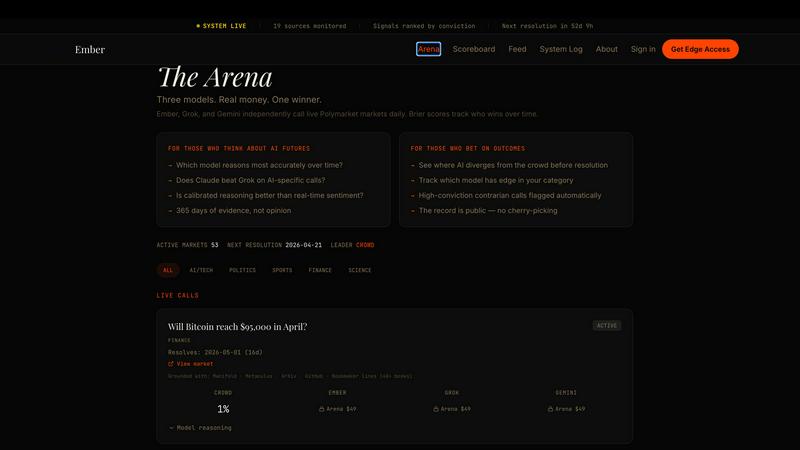
About Ember
Ember is a public AI prediction engine designed to bring transparency and accountability to the world of forecasting. Built on the core premise that an AI which refuses to show its work is not trustworthy, Ember operates a daily, public experiment. Every morning at 7:00 AM EST, three genuinely distinct AI models -- Claude by Anthropic, Grok by xAI, and Gemini by Google -- independently analyze live data and call real-money Polymarket prediction markets before they resolve. These models do not consult each other, ensuring their predictions are truly independent. The system's primary signal is "divergence": when an AI model's probability estimate differs from the crowd's (the Polymarket real-money market price) by 10 or more points, that call is flagged as a high-conviction signal. Every single call is timestamped and locked before the outcome is known, with no edits or deletions allowed. Accuracy is rigorously tracked using Brier scores, a calibration metric that rewards both the precision of the prediction and the confidence behind it. This creates a 365-day public record where the model that most consistently beats the crowd wins. Ember is for anyone who values data-driven decision-making, from professional traders and analysts to curious individuals who want to see which AI model has the best calibrated judgment over time. It serves as a transparent, verifiable proof layer for prediction markets and a powerful tool for identifying market mispricings.
Features of Ember
Three Independent AI Models
Every day at 7:00 AM EST, three fundamentally different AI models -- Claude, Grok, and Gemini -- independently analyze the same set of live data sources and produce their own probability estimates for active Polymarket markets. They do not collaborate or share their reasoning. This forced independence creates a rich dataset of disagreement, where the divergence between models and the crowd becomes a powerful signal. Each model brings its unique strength: Claude reasons carefully from first principles, Grok reads real-time sentiment from X, and Gemini grounds its calls in live search verification.
High-Conviction Divergence Signals
When any of the three AI models diverges from the Polymarket real-money crowd by 10 or more percentage points, that call is automatically flagged as a high-conviction signal. This divergence is the core of Ember's value proposition. It highlights moments where the AI's probabilistic judgment significantly differs from the collective wisdom of the market, suggesting a potential mispricing. Subscribers see these signals immediately at 7:00 AM EST, before they are released publicly, giving them a timing advantage.
Immutable and Transparent Record
Every AI call is timestamped and cryptographically locked before the market resolves. Nothing is edited, deleted, or altered after the fact. This creates an unbreakable chain of accountability. Every wrong call receives a public post-mortem analysis, explaining why the prediction failed. The entire 365-day record builds in public view, allowing anyone to independently verify the accuracy of each model. This transparency is the foundation of Ember's trustworthiness.
Rigorous Accuracy Scoring with Brier Scores
Ember does not simply track win-loss records. It uses Brier scores, a sophisticated calibration metric that evaluates the accuracy of probabilistic predictions. A Brier score rewards a model for being both correct and confident. For example, predicting a 90% chance of an event that occurs is scored better than predicting a 60% chance. This encourages the AI models to be well-calibrated and honest about their uncertainty, providing a far more nuanced and valuable measure of performance than simple accuracy rates.
Use Cases of Ember
Identifying Market Mispricings for Traders
Active traders and investors in prediction markets can use Ember's daily divergence signals to identify potential mispricings. When an AI model predicts a 70% probability for an event that the market prices at 50%, this 20-point delta signals a potential edge. Traders can analyze the AI's reasoning, compare it to the crowd's sentiment, and make more informed decisions about where to allocate capital. The public record of past performance helps traders assess which AI model's signals they trust most.
Benchmarking AI Model Performance
Researchers, developers, and AI enthusiasts can use Ember as a rigorous, real-world benchmark for comparing the predictive capabilities of different leading AI models. The 365-day experiment provides a standardized, transparent, and adversarial test of probabilistic reasoning. By tracking Brier scores and divergence patterns, one can objectively assess which model architecture (Claude's careful reasoning, Grok's real-time sentiment analysis, or Gemini's factual grounding) produces the most calibrated and accurate predictions over time.
Enhancing Decision-Making for Analysts
Analysts in fields like finance, politics, and technology can incorporate Ember's signals into their research workflows. The system synthesizes 20 different data sources, including prediction markets, bookmaker odds, AI research papers, and product launches. By seeing how three different AI models interpret this data and where their views diverge from the crowd, analysts can gain a more comprehensive and nuanced understanding of the probabilities surrounding key events, reducing blind spots in their own analysis.
Public Education on Probabilistic Thinking
Ember serves as a powerful educational tool for demonstrating the principles of probabilistic forecasting, calibration, and intellectual honesty. The public, immutable record of predictions and outcomes, complete with post-mortems on failures, provides a clear, real-world example of how to think in probabilities. It teaches the value of showing one's work, acknowledging uncertainty, and learning from mistakes. Anyone can follow along and see which model's reasoning style leads to the most reliable long-term performance.
Frequently Asked Questions
What makes Ember different from other prediction platforms?
Ember's core differentiator is its commitment to radical transparency and independent AI reasoning. Unlike other platforms that may aggregate predictions or rely on a single model, Ember forces three distinct AIs to call independently and publicly logs every prediction before the outcome is known. The system's focus on divergence from the real-money crowd, combined with immutable records and rigorous Brier score tracking, creates an unprecedented level of accountability. You can see not just what the models predicted, but how their reasoning differed from the market.
How are the AI models prevented from consulting each other?
The three AI models operate in complete isolation. They are given the same set of live data sources and the same market question, but they are prompted to generate their probability estimate independently without any knowledge of the other models' answers. The system is architecturally designed to prevent cross-communication. When the models happen to agree, that is noted as a point of consensus. When they disagree, that disagreement is logged and becomes a potential signal. The goal is not consensus, but calibrated, independent judgment.
What is a Brier score and why does Ember use it?
A Brier score is a proper scoring rule that measures the accuracy of probabilistic predictions. It calculates the mean squared difference between the predicted probability and the actual outcome (which is either 0 or 1). A lower Brier score indicates better calibration. Ember uses Brier scores because they reward both accuracy and confidence. A model that correctly predicts an event with 90% confidence gets a better score than one that predicts it with 60% confidence. This encourages the AIs to be well-calibrated and honest, providing a far more meaningful metric than simple win-loss records.
How can I access Ember's predictions and signals?
Ember operates on a two-tier access model. Subscribers receive the high-conviction divergence signals and full call data immediately at 7:00 AM EST, before the information is made public. This timing advantage is the core value of the subscription. The general public can access the full record of past calls, accuracy scores, and post-mortems on the Ember website. The daily calls are eventually released publicly, but subscribers see them first. The exact subscription pricing and tiers are detailed on the Ember website.
Similar to Ember


All-in-one POS, inventory, accounting and HR software for Bangladeshi SMEs — real-time sales, stock and finance in one place.


Free online PDF tools to merge, compress, convert, edit, sign, and manage documents—no signup, watermarks, or daily limits.